Your van goes in with a rattle, a warning light, or in the worst cases it does not go in at all because it stopped on the ring road. The garage comes back with a diagnosis you did not want: internal engine damage, and the belt has gone.
If you run a Transit or a Transit Custom with the 2.0 EcoBlue engine, this is a conversation we have several times a week. Here is what has actually happened inside the engine, why it usually ends in a replacement rather than a repair, and what it costs to get the van earning again.
What the wet belt does and why it fails
The 2.0 EcoBlue uses a belt that runs inside the engine, submerged in oil, driving the oil pump. Ford is not alone in this. A wet belt is quieter than a chain and helps with emissions, which is why several manufacturers moved to the design.
The problem is that the belt sits in hot oil for its entire life. Over time and mileage the material breaks down, and as it degrades it starts shedding small particles of itself into the oil.
Those particles are the real issue. They circulate with the oil and collect in the oil pickup, the strainer that feeds the oil pump. Once that pickup starts to block, oil pressure drops. An engine with falling oil pressure is an engine wearing itself out at speed, and the damage spreads to the bearings, the crank and the turbo.
By the time most drivers notice something is wrong, the belt has been quietly breaking down for a long while.
The belt itself rarely snaps first. What usually kills the engine is the debris it sheds long before that, blocking the oil pickup and starving everything of pressure.
Warning signs worth acting on
Catching this early makes a real difference to the outcome, so it is worth knowing what to look for.
The oil pressure warning light.
Any oil pressure warning on an EcoBlue should stop the van immediately. Not at the next junction, not at the end of the round. Continuing to drive with low oil pressure turns a serious job into a terminal one.
Oil level dropping between services.
Not always related, but worth investigating on this engine rather than just topping up and carrying on.
A rattle or knock on cold start.
Particularly from the bottom of the engine. A brief rattle that settles is often the first sign that oil is not getting where it needs to be quickly enough.
Debris in the oil.
If you or your garage find black rubbery particles in the sump or on the filter at service time, that is belt material and it is a clear warning.
Rough running or a check engine light
relating to timing, which can point to belt wear affecting the timing side.
If you are seeing any of these, the sensible move is to have it looked at now rather than after a long motorway run.
Why it usually means a replacement engine
This is the part owners find hardest to accept, and understandably so.
When a wet belt fails properly, the damage is rarely confined to one component. The debris has been through the whole oil system. The bearings have run without adequate pressure. The crank journals may be scored. Often the turbo has taken damage too, because it is fed by the same oil supply.
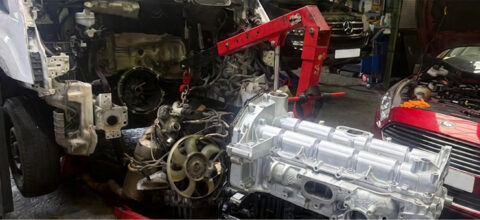
You can strip an engine in that condition and recondition it, and sometimes that is the right answer, which is why we still do that work. But on the EcoBlue the extent of the damage frequently means the cost of a proper rebuild gets close enough to a new engine that the new engine is simply the better buy. You end up with an engine with no history, no wear and a warranty, instead of a rebuilt one carrying whatever damage was not visible during the strip.
We will tell you honestly which way it falls on your van. If a recondition genuinely makes more sense, we will say so.
What it costs
We supply and fit brand new 2.0 EcoBlue engines from £4,900 plus VAT, on a fixed price rather than an open ended estimate.
The reason we can quote a fixed price where a lot of garages cannot is simply that we do this job constantly. A garage replacing an EcoBlue once or twice a year is relearning it each time, and their quote carries caveats to cover that. We know exactly what is involved.
It is worth asking anyone quoting you cheaper exactly what engine they intend to fit. A used engine out of a scrapped vehicle might look better on the invoice, but you have no idea of its mileage, its service history, or whether its own wet belt is halfway through the same process that killed yours.
A cheaper quote is not always a cheaper job. If the engine going in is second hand, you are inheriting somebody else’s unknown history along with it.
The downtime question
For a van, the cost of the engine is only part of the equation. Every day off the road is a day not earning.
That is the other advantage of a job we do regularly. We can give you a realistic timescale up front instead of a vague window, because we know how long the work takes and we know the supply position on these engines. If your van is your business, that predictability matters as much as the price.
A note for VW Transporter owners
The current VW Transporter is built on the Transit Custom platform and uses the same 2.0 EcoBlue engine. If you run one, everything above applies to you as well, and it is the same job for us.
What to do next
If your Transit or Transit Custom has suffered a belt failure, or you have been told the engine has gone, send us your registration. The registration tells us the exact engine variant, which is what determines the price, so we can usually come back with a fixed figure quickly.
And if you are not certain a replacement is really necessary, call us anyway. We would rather spend ten minutes on the phone telling you honestly what your options are than have you spend money you did not need to spend.