Being told your engine needs replacing is bad enough. Being told it on a car worth a few thousand pounds raises a harder question: is it even worth doing?
If you drive a Fiesta, Focus or Puma with the 1.0 EcoBoost, that is a fair question and it deserves a straight answer rather than a sales pitch. Here is what goes wrong with these engines, and an honest way to work out whether fixing yours makes sense.
Why the 1.0 EcoBoost fails
The 1.0 EcoBoost is a three cylinder petrol engine, and like the larger EcoBlue diesel it uses a belt that runs in oil.
The belt drives the oil pump and sits permanently in hot engine oil. Over the years the material degrades, and as it does it sheds fine particles into the oil. Those particles migrate to the oil pickup and gradually restrict it.
Once the pickup is blocked enough, oil pressure falls. The engine keeps running, often for a while, but everything inside it is now wearing far faster than it should. The bearings suffer, the turbo suffers, and eventually something lets go.
The frustrating part is how quiet the early stages are. Nothing sounds wrong. The car drives normally. The damage is accumulating out of sight.
On a wet belt engine, the failure has usually been building for tens of thousands of miles before the driver notices anything at all.
Symptoms to watch for
An oil pressure warning light.
Stop the car. This is not a light to drive home on. Getting recovered costs a fraction of what continuing to drive will cost.
Oil disappearing between services.
Worth checking regularly on this engine rather than assuming it is normal consumption.
A rattle on cold start, especially from low down in the engine, or a rattle that lasts a couple of seconds before settling.
Rubbery black debris on the oil filter or in the sump when the car is serviced. That is belt material.
Rough running, misfires or a timing related fault code.
If any of these appear, get it inspected promptly. The gap between an early catch and a major failure is often the difference between a manageable bill and a new engine.
When the engine goes, what has usually happened
By the time an EcoBoost is running badly or has stopped, the debris has generally been through the whole oil system. Bearings have run short of pressure. Crank journals may be scored. The turbo is fed from the same oil supply and often takes damage with it.
That is why these engines are usually replaced rather than repaired. It is not that a rebuild is impossible, it is that once you have accounted for everything the low oil pressure has affected, the cost of doing the job properly closes in on a new engine, and a new engine comes with no unknowns.
The honest question: is it worth it?
Here is where we will be straighter with you than you might expect from a garage.
Sometimes the answer is no.
If the car is high mileage, has other significant problems, is due major work anyway, or is genuinely close to the end of its useful life, spending the cost of a new engine on it may not be the right call. We would rather tell you that than take the job.
But there are plenty of situations where it clearly is worth doing:
The car is otherwise sound. Good bodywork, recent tyres, clutch and brakes in decent order, no other looming bills. A new engine on a solid car buys you years.
You know the car’s history. You have owned it from new or nearly new, it has been serviced properly, and you know exactly what you have got. That is worth a lot compared with buying a used car and inheriting someone else’s unknowns.
Replacement cost is the real comparison. The question is not whether the engine costs more than the car is worth on paper. It is whether the engine costs less than buying an equivalent car in similar condition, plus the tax, the insurance change, and the risk that the replacement has issues of its own.
The car suits you. Sounds soft, but it counts. A car that fits your life and that you actually like is worth more to you than its trade value suggests.
The right comparison is not the engine against the value of the car. It is the engine against the cost and the risk of replacing the whole car.
What we fit and how it works
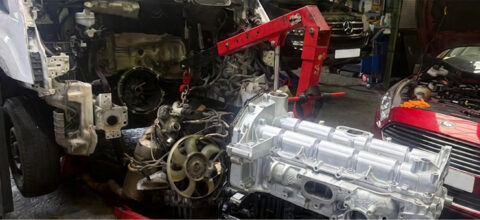
We supply and fit brand new 1.0 EcoBoost engines at our workshop in Aston, Birmingham. New, direct from the manufacturer, with no mileage and no history behind it.
We do not fit used engines pulled from scrapped cars. On a wet belt engine in particular that is a poor bet, because a second hand unit may be well into the same degradation process that finished off yours, and nobody can tell you how far along it is.
The process is straightforward. We confirm the engine genuinely needs replacing, give you a price, order the engine, fit it in our own workshop, road test it and hand the car back covered by warranty.
What to do next
Send us your registration and a short description of what has happened. The registration identifies the exact engine variant, which is what we need to price it accurately.
If you are still deciding whether to fix the car at all, call us and talk it through. We will give you an honest view of the damage and what it will take to put right, and if we think you would be better off putting the money elsewhere, we will tell you that too.